Enterprise
ERP software development and implementation
Inovsion builds and implements ERP platforms for organisations in Dubai, Riyadh, Jeddah and India — finance, inventory, procurement, manufacturing, HR and sales on one set of records, with UAE VAT and Saudi ZATCA e-invoicing handled inside the system rather than bolted on afterwards.
An ERP is not really a software purchase. It is a decision about who owns which number. The difficulty is rarely the code — it is agreeing that the warehouse team's stock figure and the finance team's stock figure are now the same figure, and that whoever updates it late is visibly late. Software makes that agreement enforceable; it cannot make it for you. That shapes how we scope: the modules are the easy part, the master data and process ownership are not.
We work both ways — configuring an existing product where one fits, and building custom application modules where it does not.

An honest note on timelines. Any vendor quoting a fixed go-live date before seeing your chart of accounts, item master and approval rules is guessing. The variable that moves the date is almost never development speed — it is data migration and the number of exceptions your business genuinely needs.
What we build
The modules we implement most often. Few clients need all of them on day one.
Finance and accounting
Ledger, payables and receivables, multi-currency, bank reconciliation and period close. Tax is configured per entity, so a UAE and a Saudi company in one group run different rules without separate installs.
Inventory and warehousing
Item master, batch and serial tracking, multi-location stock, transfers and valuation. We settle FIFO versus weighted average with your accountant before we build, not after.
Procurement and supply chain
Requisitions, approval chains, purchase orders, goods receipt and three-way matching against the invoice. More on our supply chain solutions page.
Manufacturing
Bills of material, routings, work orders, requirements planning and quality checkpoints. Suited to discrete and light process manufacturing; heavy process industries need specialist systems.
HR and payroll
Employee records, leave, attendance, end-of-service accruals and a self-service portal. Payroll rules differ enough across the UAE, Saudi Arabia and India that each gets its own configuration, not one engine with flags.
Sales, CRM and pricing
Quotations, order processing, price lists, discount approvals and commission. Where sales is the centre of gravity rather than a module, CRM development is the better starting point.
Integrations
Banks, payment gateways, storefronts, POS terminals, carriers and tax portals. This is where ERP projects run long, so integrations get their own contracts and tests rather than a line item at the end.
Reporting and dashboards
Operational reports inside the ERP, plus a separate business intelligence layer when questions get heavier. Big analytical queries against the live transactional database are the commonest self-inflicted performance problem we are called in to fix.
Custom build, product configuration, or both
The first real decision is not which vendor. It is how much of your process is genuinely distinctive. Standard finance, procurement and payroll are standard for a reason — thousands of companies have already argued about them and the answers are in the product. What is worth building is the part that is yours: the pricing logic that wins deals, the workflow competitors cannot copy.
| Configure a product | Custom build | Hybrid (our usual answer) | |
|---|---|---|---|
| Time to first release | Fastest — core modules exist | Slowest — everything is written | Fast core, slower custom edge |
| Fit to unusual process | Poor without heavy customisation | Exact | Exact where it matters |
| Upgrade path | Clean near standard; painful once deeply customised | You own it — no vendor upgrades to absorb | Core upgrades cleanly if custom stays outside |
| Licensing | Ongoing per-user or per-module | None, but you carry maintenance | Licences on core only |
| Risk sits with | Vendor roadmap and pricing | Your team's capacity | Split — the seams need discipline |
The row that quietly decides the others is the upgrade path. Deep customisation inside a product is where ERP platforms go to freeze: every vendor release becomes a regression-testing project, so eventually you stop upgrading and end up running something unsupported. Keeping custom logic outside the product boundary — as services or satellite modules — is why we prefer the hybrid shape, and why the interesting engineering ends up at the seams.
Data migration is the project
If one thing sinks a go-live, it is data. Legacy systems carry duplicate customers, items with three spellings, opening balances that do not tie out, and purchase orders left open for years — none of which shows up in a demo. We profile real data in the first weeks, and run a full dress-rehearsal migration before cutover so the real thing is a repeat rather than a first attempt.
What is different in the UAE, Saudi Arabia and India
ERP is where regional requirements stop being cosmetic. A platform that ignores them is not merely inconvenient — it is non-compliant.
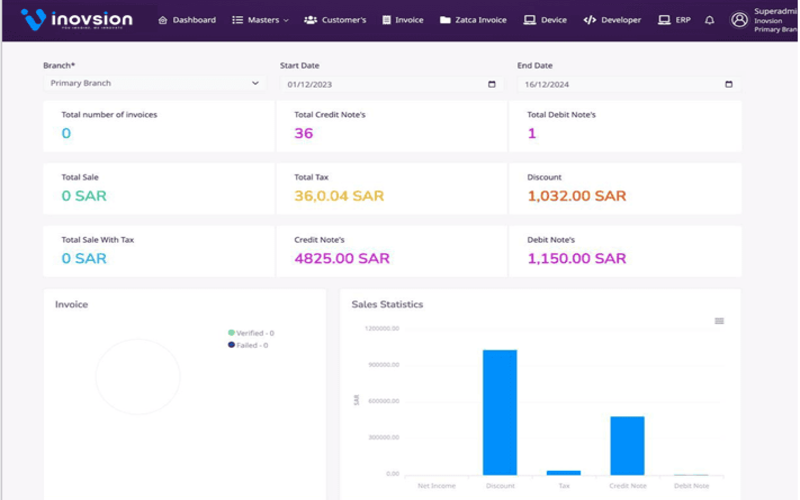
Saudi Arabia — ZATCA e-invoicing. The biggest single regional constraint, because it changes what an invoice is. Phase 1 requires a structured electronic invoice with a QR code on simplified invoices. Phase 2 requires Fatoora integration: UBL 2.1 XML, cryptographic stamp, EGS onboarding and CSID issuance, a UUID per document, and previous-invoice-hash chaining. Standard B2B and B2G invoices need clearance before they are valid; simplified B2C invoices are reported within 24 hours. We have delivered an ERP-integrated ZATCA e-invoice solution covering EGS onboarding and automated compliance across a broad range of ERP systems. The lesson: design invoice numbering and credit notes around the chaining rules from the start, or rework the ledger later.
UAE — VAT and entity structure. Tax registration numbers, compliant tax invoices, reverse charge and the mainland-versus-free-zone split all land in the finance module. Groups spanning several emirates or zones need consolidation that respects those boundaries rather than one merged ledger.
Arabic and RTL. Bilingual is not a translation file. Right-to-left layout affects tables, number alignment and printed invoice templates, and Arabic names change how you de-duplicate master data — far cheaper as a design constraint than a later request, a point our UI/UX team raises in the first workshop.
Data residency. Regulated sectors and some government-linked contracts require data to stay in-country. Regional zones exist on the major clouds — we work with AWS, Azure and Google Cloud — but the choice must be settled before architecture, because it constrains which managed services you can use.
India. GST filing, e-way bills and state-level rules are their own configuration. For groups spanning India and the Gulf, the sane pattern is one platform with separate tax engines per country — not one engine covering both.
How we deliver
1. Discovery
We walk your real process — order to cash, procure to pay — with the people who run it, and profile a data extract. Output: a process map, a data quality report, and an honest list of what is standard versus yours.
2. Architecture and scope
Module selection, build-versus-configure calls, integration contracts, the permissions model, hosting and residency, tax configuration per entity. Phase one is narrowed to what earns its keep first.
3. Build and validate
Iterative delivery, with your key users testing against migrated data rather than demo data. Automated tests on the calculation-heavy paths — tax, pricing, valuation, payroll — because nobody notices those are wrong until the audit.
4. Launch and support
Rehearsed cutover with a written rollback plan, training by role rather than by module, and hands-on support through the first period close — the moment the system is actually judged.
Common technologies
Chosen to fit your existing estate and skills.

.NET
Custom modules and services.

SQL Server
Transactional database, reporting kept off it.

Oracle
Where an Oracle estate already exists.

Power BI
Analytical layer beyond operational screens.
Why Inovsion
We will tell you not to build it
If a configured product covers most of what you need, that is the advice you will get — even though a custom build is the larger contract. The projects that go badly are the ones oversold at scoping.
Regional compliance is not an add-on
We have delivered an ERP-integrated ZATCA e-invoicing solution with EGS onboarding across a broad range of ERP systems. VAT, Arabic and residency are architecture here, not a late change request.
We stay for the first close
An ERP is judged on the first month-end after go-live, not on the demo, so our engagements include that period. Examples of delivered work are on our portfolio.
Frequently asked questions
How long does an ERP implementation take?
It depends almost entirely on data quality and the number of genuine exceptions in your process, not on the module count. A tightly scoped first phase — finance plus one operational area — is a very different project from an all-modules big-bang. We give a range after discovery, once we have profiled your data.
Should we go live all at once or module by module?
Phased, in most cases: big-bang cutovers concentrate all the risk into one weekend and leave nowhere to retreat to. The exception is when modules are so interdependent that phasing means building throwaway bridges to the legacy system — then a single cutover can genuinely be cheaper.
Can the ERP handle ZATCA e-invoicing in Saudi Arabia?
Yes — that is work we have delivered. Phase 2 needs Fatoora integration, UBL 2.1 XML, cryptographic stamping, EGS onboarding with CSID issuance, UUIDs and hash chaining. The important part is designing invoice numbering and credit notes around the chaining rules up front.
Do you integrate with our existing systems?
Usually yes — banks, e-commerce platforms, POS, carriers and tax portals are all common. The question we ask first is what the other system actually exposes: a documented API, a file drop, or a database nobody is supposed to touch. That answer moves the estimate more than anything else.
Talk to us about your ERP
Tell us what you run today, where the re-keying happens and what your auditors ask for. We will give you a straight view on scope, sequence and whether ERP is even the right answer.