Mobile Apps
Flutter App Development Company in Dubai & Saudi Arabia
One Dart codebase, compiled to native ARM for both iOS and Android. We build Flutter apps for clients in Dubai, Riyadh, Jeddah and India — and we will tell you honestly when Flutter is the wrong tool for the job.
Flutter is Google's open-source UI toolkit. Unlike wrapper frameworks that render your interface in a hidden web view, Flutter ships its own rendering engine and paints every pixel itself. That is why a well-built Flutter app feels smooth rather than "web-ish": there is no JavaScript bridge between your code and the screen, and release builds compile ahead-of-time to native machine code.
The commercial argument is simpler. Most business apps — a field service tool, a booking flow, an ERP companion app — are largely shared logic and shared UI. Writing that twice, in Swift and Kotlin, means two codebases, two release cycles and two teams who drift out of sync. Flutter collapses that into one — a saving on build and maintenance effort, not a licence to skip design or testing.
It has limits. Flutter draws its own widgets, so a Cupertino-styled control is an interpretation of an iOS control, not the real one — if pixel-exact platform fidelity is a hard requirement, native is the honest answer. Binaries also carry the engine, and brand-new OS APIs may need a platform channel in Swift or Kotlin first.
An honest note on "write once, run anywhere". The code is shared; the product is not. You still need to test on real iOS and Android hardware, because keyboards, permission dialogs, back-gesture behaviour and store review rules all differ. Teams that budget for one platform's QA and assume the other comes free are the ones that slip at launch.
What we do
Flutter services we offer
Custom app development
End-to-end builds from a blank repository: architecture, state management, API layer, UI, tests and store release — layered so business logic stays testable.
Native to Flutter migration
Rewriting a working app wholesale is rarely the right call. Flutter embeds into an existing native app screen by screen, so you migrate the high-churn areas first.
Platform channels & native plugins
When pub.dev has no package for what you need — a payment SDK, a BLE peripheral, a card reader — we write the Swift and Kotlin side and expose it to Dart through a typed platform channel.
Design systems & UI engineering
Widget composition suits design systems well. We build a themed component library once — typography, spacing, colour, dark mode, RTL — so a rebrand is a theme change, not a rewrite.
Backend & API integration
An app is only as good as what it talks to. We build or integrate REST and GraphQL APIs, handle auth and token refresh, and connect to the ERP, CRM and payment systems already in place.
Testing & QA
Unit tests for logic, widget tests for components, integration tests for critical journeys, plus real devices on both platforms. Flutter's test tooling is good; we use it rather than click-through checks.
Performance tuning
Jank in Flutter is usually diagnosable: unnecessary rebuilds, expensive work on the UI isolate, oversized images. We profile with DevTools and fix causes rather than guessing.
Release, CI/CD & support
Signing, flavours for dev/staging/production and automated distribution to TestFlight and Play Console. After launch we keep dependencies current and crash rates monitored as the platforms raise SDK targets each year.
Deep dive
How we actually build a Flutter app
Architecture before widgets
The most common failure we see in inherited Flutter codebases is business logic living inside widgets. It works until the second developer arrives, and then every change risks a regression somewhere unrelated. We separate presentation, domain and data from the start: widgets render state and emit intent, nothing more.
For state management we have no religion — Riverpod, BLoC and plain
ChangeNotifier all ship good products. What matters is that one pattern
is chosen deliberately and understood by whoever maintains the app after us.
Offline is a design decision
Connectivity in a basement car park or a desert site office is not a rare edge case. We decide early which data must be readable offline and what happens when a queued action conflicts with the server. Retrofitting this is expensive; deciding it in week one is nearly free.
Flutter compared with the alternatives
No framework wins on every axis. This is roughly how we weigh the options when a client asks which route to take — a starting point for a conversation, not a scorecard.
| Consideration | Flutter | React Native | Fully native (Swift / Kotlin) |
|---|---|---|---|
| Language | Dart | JavaScript / TypeScript | Swift and Kotlin — two codebases |
| How the UI is drawn | Own engine paints every pixel | Maps to real platform components | Real platform components |
| Platform fidelity | Close; Cupertino widgets are re-creations | High — the controls are real | Exact, by definition |
| App size floor | Larger — engine ships with the app | Moderate | Smallest |
| Brand-new OS APIs | May need a platform channel | May need a native module | Immediate |
| Existing web/JS team | Dart is new, though quick to learn | Reuses skills you have | Least transferable |
| Where we would pick it | Branded, design-system-led apps; ERP and field tools | Teams deep in the React ecosystem | Heavy hardware use, or fidelity is contractual |
If your team already runs React across the web, our React Native practice may fit better. If the app is fundamentally about hardware, sensors or deep OS integration, our iOS and Android native teams are the right call. We would rather point you to the correct tool than sell you the one on this page.
The app is half the system
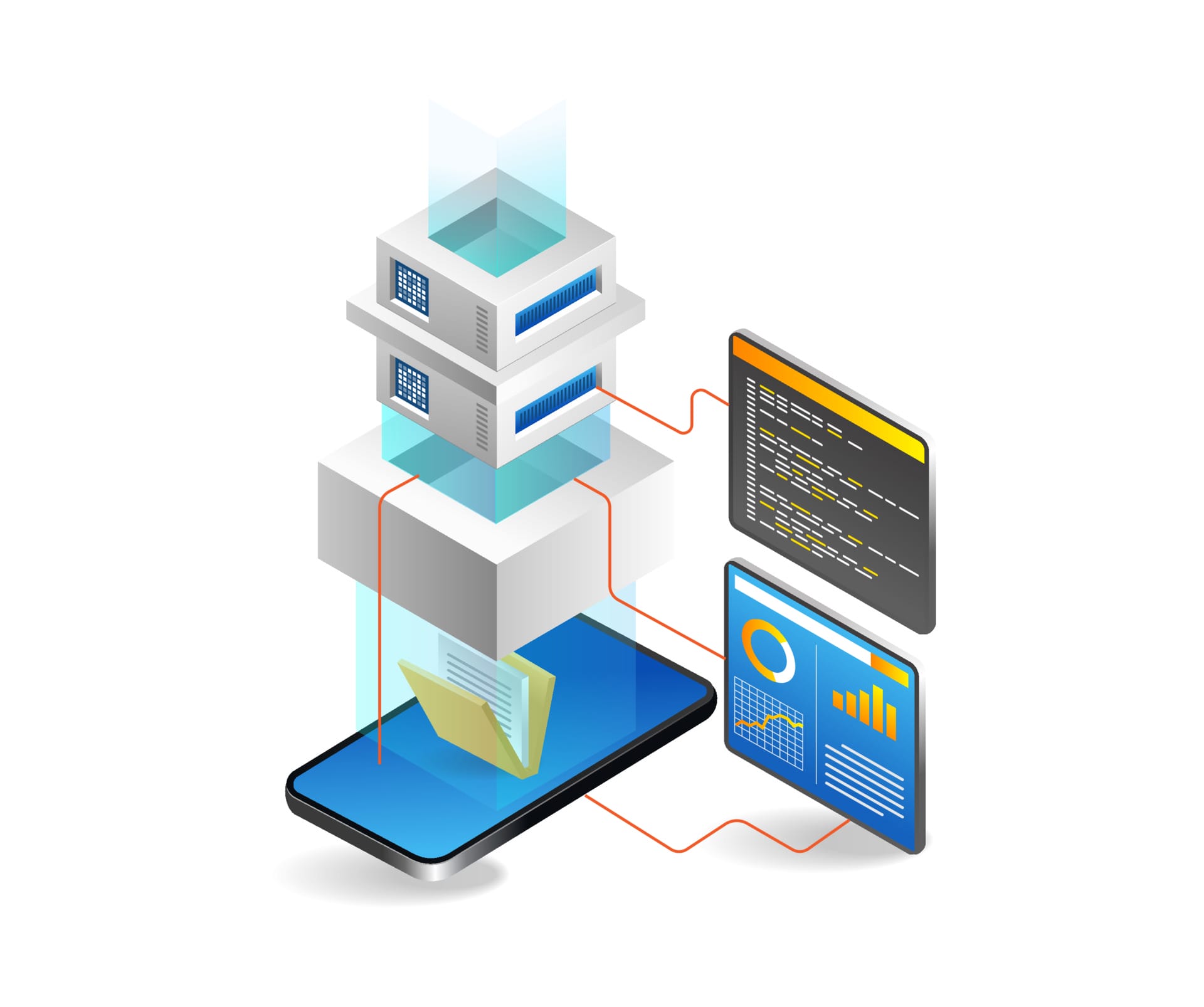
Almost every Flutter project we deliver has a server behind it. We treat the two as one system rather than two projects, which avoids the familiar situation where the mobile and backend teams each believe the other owns a problem. That work draws on the teams behind our backend development and custom application practices, hosted on AWS or Azure.
Technologies we typically use
A representative stack; the exact choice depends on your existing systems and who will maintain the app afterwards.

Flutter & Dart

Android / Kotlin channels

iOS / Swift channels

Figma design handoff

Node.js APIs

.NET APIs
Python services

TypeScript

MongoDB

SQL Server

AWS

Azure
Regional context
What is different about building for the UAE, Saudi Arabia and India
Arabic and RTL are not a translation task. This is the biggest regional
factor and the one most often underestimated. Flutter's RTL support is good — set the
locale and the framework mirrors layout, padding and directional icons — but only if the
UI was built with directional properties rather than hard-coded left and right values. An
app written with EdgeInsets.only(left: 16) everywhere will mirror badly and
need reworking. Arabic script also needs proper shaping and more generous line height, and
Arabic strings often run longer than the English a designer sized the mock-ups around. We
test in Arabic from the first sprint.
Payments are local. Card acceptance here routinely means providers with a local presence. In Saudi Arabia, mada is central and should not be assumed to work through a generic international gateway; UPI dominates in India. Each tends to mean a native SDK wrapped in a platform channel — worth scoping before the estimate rather than discovering in week six.
Tax and invoicing surface in the app. If your app issues invoices or receipts in Saudi Arabia, ZATCA e-invoicing applies to the system behind it. Phase 1 covers generation — a structured e-invoice with a QR code on simplified invoices. Phase 2 adds Fatoora integration: UBL 2.1 XML, a cryptographic stamp, CSID and EGS onboarding, UUIDs and PIH chaining, with clearance for standard B2B and B2G and reporting within 24 hours for simplified B2C. The app is usually a client of that system, but the two must be designed together. We have delivered an ERP-integrated ZATCA e-invoicing solution; EGS onboarding is the step teams underestimate.
Data residency. Where user data physically sits comes up early in regulated sectors across the UAE and Saudi Arabia. It shapes cloud region choice, and is far cheaper to answer before you build.
Process
How we deliver
Discovery
What the app must do, who uses it and on what devices, which languages it ships in, and what it integrates with. This is also where we decide honestly whether Flutter is the right choice — sometimes the answer is no.
Architecture & scope
State management pattern, module structure, API contracts, offline and sync rules, RTL strategy, and a scope we will stand behind. Anything needing a platform channel is identified here, not later.
Build & validate
Two-week iterations, each ending in a build you can install on a real device. Tests run in CI on every commit, in Arabic and English, on iOS and Android — not in a QA phase bolted on at the end.
Launch & support
Store submission on both platforms, crash and performance monitoring from day one, and a maintenance arrangement that keeps pace with annual OS releases.
Why Inovsion
Why work with us on Flutter
Apps we have actually shipped
Delivered work rather than concepts: ClueMaster (IoT escape rooms), Rising Walls (a property portal), FameKeeda (an influencer app), HiCare (e-commerce), Energy Central (news), OneTuch (logistics and medical emergency) and a food ordering app. See our work.
Straight advice on trade-offs
We will tell you when native is the better answer, when a progressive web app would do, and when the honest scope is larger than you hoped. That conversation is cheaper before the contract than after it.
Frequently asked questions
Is Flutter genuinely as fast as a native app?
For most business and consumer apps, yes — release builds compile ahead-of-time to native ARM code and the engine renders directly, so there is no bridge to cross. Native still wins on sustained heavy graphics and when you need an OS API the moment it ships. If your app is a game, use a game engine instead; our game development team can advise.
How much cheaper is Flutter than building two native apps?
We will not quote a percentage, because anyone who does is guessing. The saving comes from maintaining shared logic and UI once instead of twice — but design, testing on both platforms, backend work and support are not halved. Tell us what you are building and we will scope it rather than quote a ratio.
Can Flutter handle Arabic and right-to-left layouts properly?
Yes, provided the app is built for it. Flutter mirrors layout, padding and
directional icons automatically when you use properties such as
EdgeInsetsDirectional rather than hard-coded values. The framework is
not the constraint; the discipline is. Converting an app written left-to-right-only
afterwards is slow, avoidable work.
Can you add Flutter to our existing native app instead of rewriting it?
Usually, yes. Flutter can be embedded into an existing iOS or Android app as a module, so you migrate one flow at a time and keep releasing. It adds build complexity — worth it when you have a substantial app that works, less so when the codebase is already due for replacement.
Who owns the code, and can our own team take it over?
You own the code. We work in your repository where you have one, keep the architecture conventional rather than clever, and document decisions that would otherwise live only in our heads. If you plan to bring the app in-house, tell us at the start and we will hand over with that in mind.
Thinking about a Flutter app?
Send us what you are trying to build. We will tell you whether Flutter fits, what we would watch out for, and what a realistic scope looks like — before you commit to anything.
Email [email protected] · UAE / WhatsApp +971 50 626 8535 · India +91 98458 70246